In December 2025, the React team disclosed two new vulnerabilities affecting React Server Components (RSC). While this announcement may initially appear to be a purely frontend concern, it carries significant implications for headless and composable e-commerce architectures, where React is increasingly playing a central role.
This article explains why e-commerce teams should care, even if they are not deeply involved in React development, and what practical lessons can be taken from this incident.
A brief overview of the issue (facts only)
According to the official React announcement, two vulnerabilities were identified during the review of patches for an earlier critical issue (commonly referred to as React2Shell).
The newly disclosed vulnerabilities are:
-
High severity Denial of Service (CVSS 7.5)
A specially crafted HTTP request may cause an infinite loop on the server, potentially making it unresponsive. -
Medium severity Source Code Exposure (CVSS 5.3)
Under certain conditions, server-side source code for specific Server Functions could be exposed, which may include hardcoded secrets.
The React team states that:
-
The issue only affects projects using React Server Components
-
Safe versions include React 19.0.3, 19.1.4, and 19.2.3
-
Projects not using RSC are not impacted
Why this matters for e-commerce (even if you’re “just using React”)
Modern e-commerce platforms increasingly adopt headless and composable architectures. In these setups:
-
The storefront is often built with React + Next.js
-
Rendering and data fetching happen on the server
-
Business logic moves closer to the frontend layer
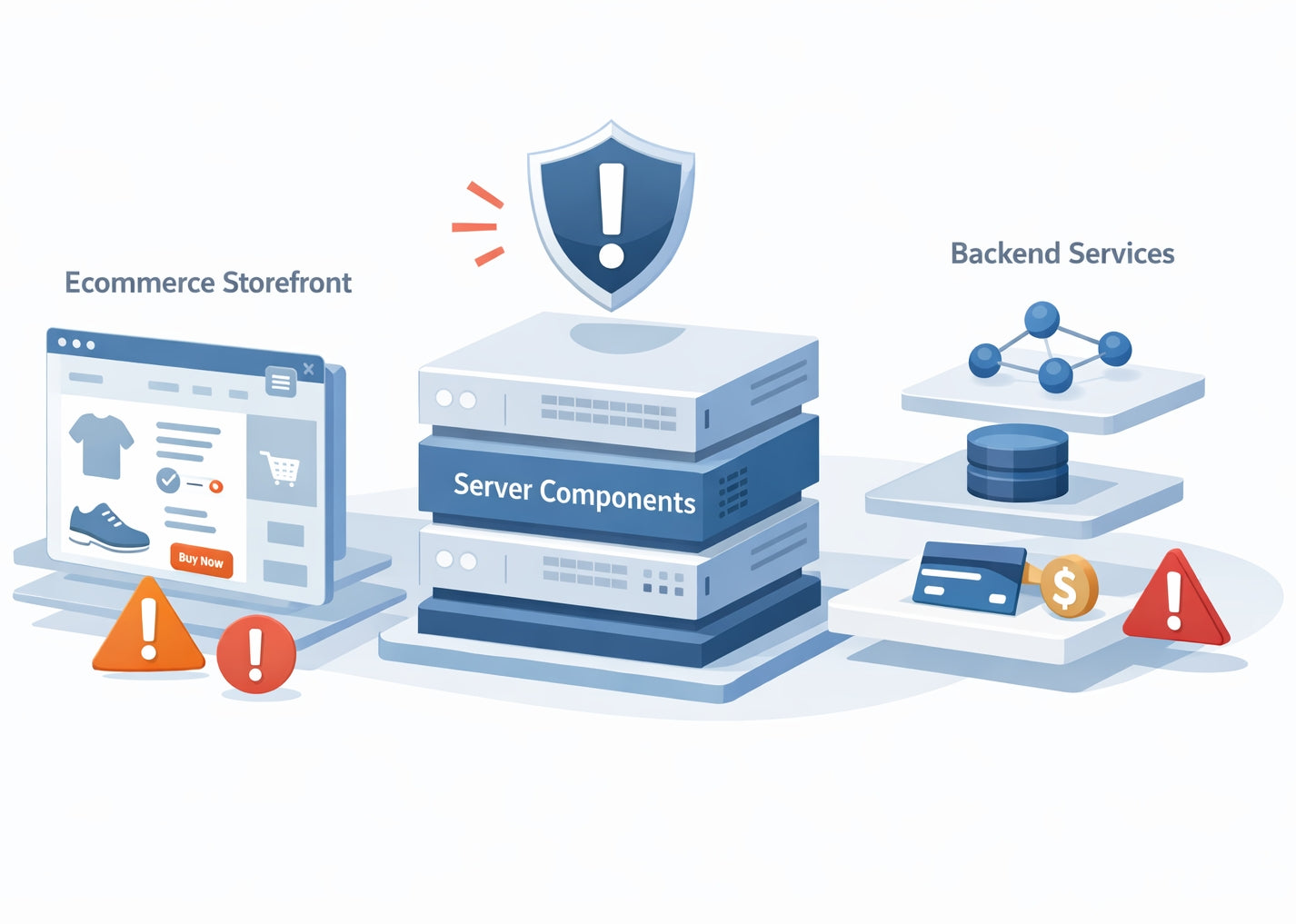
This means the frontend stack is no longer “just UI”. It becomes part of the production backend surface.
React Server Components amplify this shift by allowing code to run on the server as part of the rendering process. As a result, vulnerabilities in this layer can have direct operational and business impact.
Realistic e-commerce risk scenarios
Without speculating beyond the disclosed information, the following risks are relevant for e-commerce teams:
1. Denial of Service = Lost Revenue
A server-side infinite loop triggered by an HTTP request can:
-
Make product pages unavailable
-
Break checkout flows
-
Affect SEO and ad landing pages
For high-traffic stores, even short downtime can translate directly into lost revenue.
2. Source code exposure = increased attack surface
Source code exposure does not automatically mean data breaches, but it can:
-
Reveal internal logic
-
Expose hardcoded secrets if they exist
-
Make future attacks easier to plan
In headless ecommerce, server functions often interact with:
-
Commerce APIs
-
Payment providers
-
ERP or PIM systems
Any exposure in this layer increases overall risk.
Platform context: where e-commerce teams might be affected
This issue does not affect e-commerce platforms equally.
Potentially relevant
-
Magento / Adobe Commerce with custom Next.js frontends
-
Shopify Hydrogen
-
BigCommerce headless implementations
-
Any custom storefront using React Server Components
Likely not relevant
-
Traditional monolithic storefront
-
Stores not using React Server Components
-
Purely client-side React applications
The key factor is RSC usage, not the commerce platform itself.
Lessons for headless ecommerce teams
Even beyond this specific vulnerability, there are broader takeaways:
1. Frontend security is backend security
When frontend frameworks run server-side code, they must be treated with the same care as backend systems.
2. Composable architectures require composable responsibility
Headless setups offer flexibility, but they also distribute responsibility across more layers — each of which must be maintained and updated.
3. Staying current is not optional
Security fixes in frontend frameworks are no longer “nice to have”. They are part of operational stability.
A practical, non-technical checklist
For ecommerce teams and decision-makers:
-
Verify whether your storefront uses React Server Components
-
Confirm the React version in production
-
Avoid hardcoding secrets in server-side logic
-
Ensure basic protections like rate limiting and monitoring are in place
-
Coordinate frontend and backend update cycles
No deep React knowledge is required to act on these points.
Final thoughts
This React Server Components incident is not just about React. It highlights a broader trend in e-commerce: the merging of frontend and backend concerns.
As headless and composable commerce continue to evolve, security, performance, and reliability can no longer be cleanly separated by layers. The tools that power storefront experiences are now part of the critical infrastructure.
For e-commerce teams, the takeaway is clear: architectural flexibility comes with architectural responsibility.